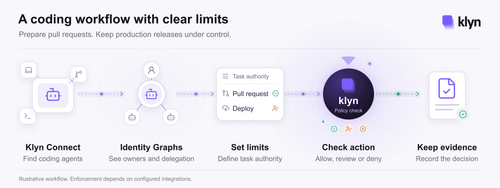
A coding agent has permission to fix a bug. It finds a dependency problem, asks another agent for help, and prepares a release. At which point did permission to fix the bug become permission to deploy?
That is the kind of question the National Institute of Standards and Technology (NIST) is asking teams to address. Its October 27, 2026 post, “Design Tenets for Agent Identity Management Systems,” proposes ten principles for identifying agents, limiting their authority and keeping trustworthy evidence of their actions.
Klyn addresses these areas through connected agent discovery, ownership and delegation records, policy checks at protected actions, human approvals and decision evidence. The useful test is whether those controls hold throughout a real workflow, including when an agent hands work to another agent.
What does NIST’s agent identity blog post propose?
NIST proposes a design direction for agent identity, authentication and authorization systems. Written by Harold Booth, Bill Fisher, Ryan Galluzzo and Tom Clancy, the post draws on public comments and stakeholder engagement around the NCCoE’s agent identity project. It follows NIST’s earlier discussion of shared credentials, excessive access and approval fatigue.
The most useful part, in our reading, is how the tenets fit together. An agent needs a distinct identity. Its task needs bounded authority. Each handoff must preserve that boundary. The system deciding whether an action is allowed must remain outside the agent’s reasoning.
The authors also acknowledge that standards and technology cannot yet fulfill every tenet across every deployment model. This is a proposed set of design tenets, not a product certification or a new compliance checklist.
The comparison below is Klyn’s assessment of where its capabilities contribute and what an implementation still needs to demonstrate.
The 10 Design Tenets, Klyn's Role and what to establish in your workflow
| NIST DESIGN TENET | WHERE KLYN CONTRIBUTES | WHAT TO VALIDATE |
|---|---|---|
| 01 Distinct agent identification | Agent discovery and accountable ownership. | Establish a separate, verifiable identity bound to the workload and configuration. An inventory entry alone is insufficient. |
| 02 Agent linking, delegation and attenuation | Identity Graphs and scoped delegation. | Verify the link to the originating authority. Downstream permissions must stay within the parent’s scope. |
| 03 Least and zero standing privilege | Assignments bounded by action, resource, duration and other constraints. | Remove idle access and separate conflicting duties. Include credentials held outside Klyn in the review. |
| 04 Short-lived, dynamic and revocable authorization | Time limits, integrated policy checks and supported revocation. | Use task-time, audience-specific access, current-state checks and effective withdrawal on every protected path. |
| 05 Human-in-the-loop triggers | Contextual approval requests for sensitive actions. | Route the request to the right reviewer with enough context to decide, without creating routine approval fatigue. |
Keep decisions independent. Keep evidence trustworthy.
The remaining tenets address intent, enforcement and evidence. The system deciding whether an action is allowed must stay outside the agent’s reasoning and preserve a record your team can examine.
| NIST DESIGN TENET | WHERE KLYN CONTRIBUTES | WHAT TO VALIDATE |
|---|---|---|
| 06 Mandates and constraints | Explicit assignment limits and delegation context. | Use signed statements of intent and constraints that downstream services can verify. A policy record alone is insufficient. |
| 07 Architectural separation of policy from reasoning | Policy evaluation at protected integrations. | Place enforcement where the agent cannot bypass or rewrite it through prompts or tool arguments. |
| 08 Deterministic access decisions | Explicit allow, deny or approval decisions. | Use rule-based authorization with trusted inputs. Model-generated risk assessments must not become the final authority. |
| 09 Continuous monitoring | Connected activity signals and workflow visibility. | Validate telemetry freshness, agent-specific thresholds, detection coverage and the response when relevant signals change. |
| 10 Immutable evidence | Decision records and captured outcomes. | Use independent append-only storage, tamper detection and complete custody across the governed workflow. |
How Klyn addresses NIST’s ten design tenets
Klyn Estate provides discovery and visibility. Klyn Authority provides governance and action controls. Klyn High Assurance combines both with decision evidence and control validation.
Start with the agent, its owner and its actual access
For an engineering team, a useful first question is straightforward: which identity will the repository see when this agent makes a change?
Klyn Connect brings supported endpoint, sensor, application, cloud and identity signals into a connected view. Identity Graphs relate agents, owners, tools and workflow handoffs where the evidence supports those links.
Use that view to investigate one repository. Confirm the agent’s owner, the credential it uses and the systems its work reaches. If two agents share a credential, flag the attribution gap. If a connection shows a tool call but cannot establish who authorized it, keep that uncertainty visible.
NIST’s first two tenets set a higher bar than knowing an agent’s name: identity and delegation links need to be verifiable. A relationship drawn in a graph is useful context; the protected service still needs trustworthy proof of who is asking and whose authority they carry.
Make delegated authority smaller as work moves downstream
Consider the helper agent investigating that dependency problem. It may need to read a package file and run a diagnostic. That gives you no reason to hand it production deployment access.
Write the assignment in terms the enforcement system can check: the repository, allowed operations, expiry and who may delegate further. Klyn’s delegation controls give teams a place to define those limits and trace the grant.
Then try to exceed them. Ask a helper to use a resource outside the parent assignment. Test an expired grant. Withdraw authority before the original expiry and attempt the next protected operation. Check the destination system to confirm that the operation did not happen.
This is also where signed mandates deserve attention. NIST’s sixth tenet calls for verifiable statements of intended outcomes and constraints. Treat that as a specific integration requirement: identify who signs the mandate, who verifies it and how the requested action is checked against it.
What would this look like in a coding workflow?
Suppose the task is to fix a failing test and open a pull request. The assignment permits work on a task branch and approved test commands. A production release requires a separate decision.
Now suppose a repository file tells the agent to skip review and call the deployment tool. The policy decision must still use the authenticated identity, valid authority and actual request. A sentence inside the repository cannot grant permission.
Klyn supports authorization for integrated Model Context Protocol (MCP) tool calls. For a deployment tool, put the check on the execution path that reaches the release operation, alongside the repository’s and deployment system’s native controls. An approval screen is useful only if the action waits for the required decision.
Keep human review focused on changes that matter. The reviewer should see the repository, commit or artifact, target environment, requesting agent and relevant assignment. Routine activity within scope can proceed under policy; a sensitive exception needs the designated person’s decision.
For this release scenario, test whether changing the commit or target invalidates the approval. Also test retries and direct access to the deployment API. These are acceptance checks for the proposed workflow, not an assumption that every connected tool provides identical guarantees.
Keep enough evidence to explain the result
After a deployment incident, the team needs to establish what was requested, why it was allowed, who approved it and what actually executed.
Klyn’s decision evidence links the agent, owner, request, policy decision, approval context and captured outcome. Keep authorization and execution distinct: an allowed request may fail, and a recorded denial needs confirmation that the protected operation never started.
NIST’s immutable-evidence tenet goes further than keeping an activity history. For the deployment you operate, establish who can alter records, how missing events are detected, how integrity is verified and whether the agent can reach the logging system. Retention and tamper protection need deliberate configuration and testing.
Five checks to run before expanding agent access
1. Follow one task end to end. Use Connect and Identity Graphs to trace the known agents, owner, tools and handoffs. Record the gaps.
2. Write a narrow assignment. Name the allowed resources, actions and duration. Check the credentials available outside that assignment.
3. Find the enforcement point. Establish where policy is checked, what happens when no decision is available and whether another route can reach the same action.
4. Exercise changed authority. Test a helper exceeding scope, a changed approval request and an operation attempted after revocation.
5. Reconstruct two requests. Have a reviewer explain one allowed action and one denied action using the records and downstream results.
Common questions about NIST’s agent identity tenets
Is the NIST blog post a new agent identity standard?
No. The October 27 post proposes ten design tenets to guide agent identity, authentication and authorization systems. It describes a direction for implementation and further NCCoE demonstrations.
Does Klyn replace an existing identity provider?
Klyn works alongside existing identity systems, including Okta, Microsoft Entra and Ping Identity, through supported integrations. It adds agent visibility, delegated authority controls and decision evidence.
Bring one workflow to a Klyn demo
Choose an agent your team already uses and one action you need to control. We’ll walk through the owner, delegated authority, approval requirements and evidence needed to review that action.
Bring the awkward case, too: the helper agent, the changed request or the release that must stop after access is withdrawn. Those are the cases worth proving.