A developer asks a coding agent to fix a failing test and open a pull request. The agent reads the repository, makes a change, and runs the tests. That’s the job.
Now consider a team running that agent with a shared automation credential. Depending on how the environment is configured, the credential might also allow changes to build workflows or access to a deployment tool. The assignment was narrow. The available authority may be much broader.
The review has to follow the work: from the developer’s machine to the repository, through any helper agents, and into the build and release pipeline. Somewhere along that path, the system must distinguish preparing a change from releasing it.
AI agent governance means deciding who is responsible for an agent, what it may do, and how those limits are enforced and reviewed. This article focuses on that authority, using a development workflow as an example.
Where Klyn fits
Klyn helps security and engineering teams connect agent visibility with control over protected actions. The aim is to understand the workflow well enough to assign responsibility, define authority, and explain the decisions made along the way.
In the current Klyn platform, Klyn Estate brings together discovery, Connect, Identity Graphs, and Atlas for a wider view of the agentic workforce. Klyn Authority covers ownership, delegation, policies, approvals, and supported revocation controls. Klyn High Assurance combines both capability sets with decision evidence and control validation.
For a first rollout, choose one agent, one repository, and one action that would matter if it went wrong.
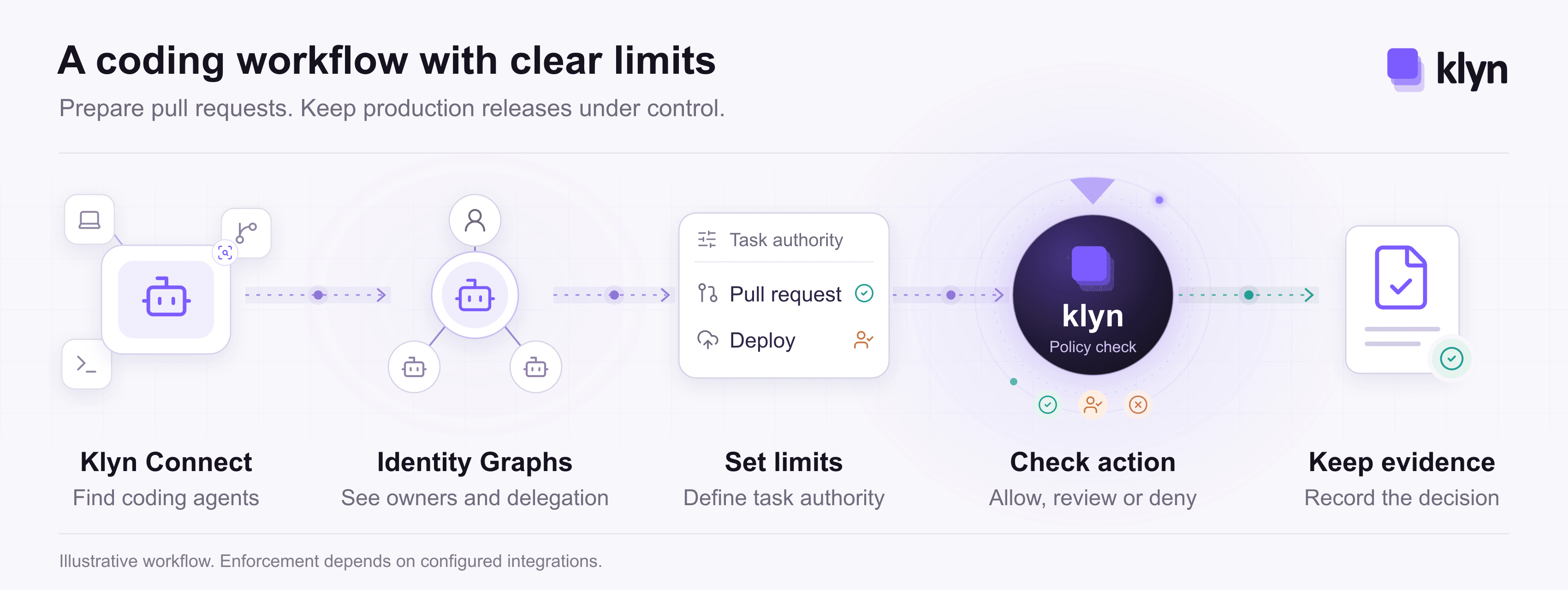
Use Connect to find the workflow
A coding agent may run locally while its work continues in cloud services. Klyn Connect brings available endpoint and sensor telemetry together with supported application, cloud, and identity signals. That helps teams investigate observed activity and handoffs across the workflow.
Start with the sources relevant to your chosen repository and build process. Then make the observations useful:
- Check what each connection sees. Note the identities, activity, or relationships it supplies, along with its permissions and refresh behavior. Verify anything uncertain in the source system.
- Confirm who owns the work. Ask the engineering team to confirm the agent’s purpose and accountable owner. The developer who installed it may not own the service it now supports.
- Mark the missing steps. If you can observe repository activity but cannot see a downstream deployment identity, record that gap before expanding the agent’s authority.
A discovery connection can reveal activity without intercepting it. Decide separately where a protected integration must enforce the rules.
Use Identity Graphs to follow responsibility
Suppose the coding agent asks a helper agent to investigate a dependency failure. Your review now needs to cover the handoff as well as the original agent.
Klyn’s Identity Graphs relate agents, owners, workflows, and connections where source evidence supports those relationships. Use the graph to trace the known path from an owner to an agent and through its delegation records.
Before granting broader access, confirm the owner and inspect the available parent and downstream grants. Compare their scope and expiry. A helper investigating a dependency should receive authority appropriate to that task.
Repeat that review when a project ends or an owner changes roles. Identify related agents and grants that need attention, then check the effect of withdrawing authority on the protected path.
A missing relationship is an unanswered question. Where access is unclear, check the repository, pipeline, or cloud permissions directly. The graph helps guide the investigation; its coverage still depends on the evidence available.
Put the approval before the action
For our coding agent, a workable assignment might read:
Work in the approved repository on a task branch. Run permitted tests and open a pull request. Production deployment requires separate approval.
That describes the intended boundary. Repository permissions, tool controls, and the protected release path must make it hold.
Keep native branch protections, code review, security scanning, and deployment controls in place. GitHub’s code-governance guidance recommends required pull requests and reviews, with rules that can dismiss stale approvals after new commits.
Also inspect what a build can access. GitHub’s guidance for agent-triggered workflows explains why running unreviewed changes in a privileged workflow can expose repository access or secrets. Preparing a pull request and running its automation deserve separate decisions.
For a release approval, identify the repository, exact commit or immutable artifact, and target environment. Re-evaluate the request if those details change. OWASP’s agent security guidance recommends binding approval to the specific action and validating authority outside the agent before execution.
Klyn Authority applies policy through supported integrations, including integrated MCP tool calls. If your agent uses the Model Context Protocol to reach a deployment tool, establish which execution path is protected. The coding example here is a control design to validate against your setup, rather than a claim that every repository or pipeline is automatically covered.
Test the boundary and inspect the record
Alongside the permitted pull-request workflow, test the requests you expect to stop:
- Attempt a protected action in a repository or environment outside the agent’s scope.
- Change the commit or deployment target after approval and check that the changed request needs a fresh decision.
- Withdraw the agent’s authority and attempt another protected operation.
Inspect the downstream system as well as the authorization response. A blocked deployment should not start through the protected path. A request allowed to proceed still needs a separate record showing whether execution succeeded.
Klyn’s decision evidence helps connect instrumented requests with the agent, owner, policy decision, approval context, and captured outcome. Agree on capture, retention, and integrity settings for your deployment so reviewers know what the record establishes.
Then ask someone who did not configure the workflow to reconstruct one allowed request and one denied request. If they need to chase several people for an explanation, you have found something worth fixing before the next rollout.
Bring your coding workflow to a Klyn demo
Start with a coding agent your team already uses, or one you are preparing to deploy. We’ll walk through how Klyn can help you investigate ownership, define authority, and review controls at the protected steps in that workflow.
Bring a repository or release scenario you want to discuss. We can use it to make the integration requirements and expected evidence concrete.