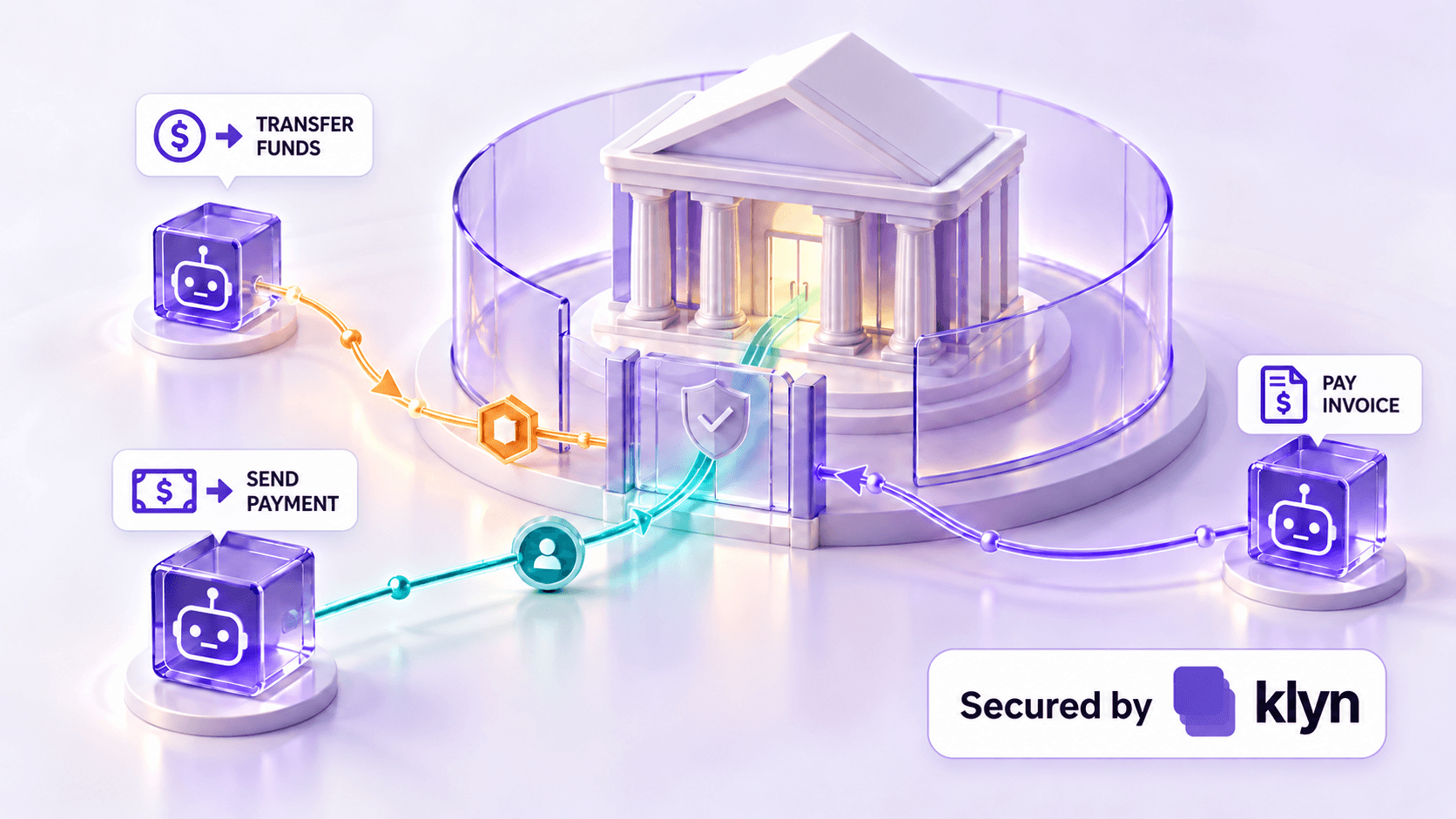
How can banks govern personal AI agents?
Banks can govern personal AI agents by verifying the agent separately from the customer, recording the customer’s specific delegation, and enforcing bank policy before each protected action. Access should be narrow, time-limited and revocable, with human approval for sensitive operations and evidence of decisions and captured outcomes.
Klyn’s role: connect agent identity, delegated authority and policy decisions at bank-integrated enforcement points. The banking workflows below are proposed deployment patterns, with coverage to be established through integration and testing.
What the Canadian and U.S. bank restrictions tell us
The next agent interacting with a bank may belong to its customer. A bank can choose its internal agents and assign their responsibilities. A personal agent arrives with instructions that the bank needs an independent way to verify.
| Canada | United States |
|---|---|
| RBC announced on October 27 that it would block third-party personal AI agents from direct access to its authenticated digital services, including online banking, citing security and privacy concerns. .TD and BMO also announced restrictions. CIBC does not support direct agent access; Scotiabank said it would limit access. . | Axios reported that banks including Morgan Stanley, Bank of America and JPMorgan were responding to unvetted agents accessing customer accounts. .Reuters subsequently reported blocking at Morgan Stanley and Charles Schwab. A source familiar with Morgan Stanley said it had not observed unauthorized or rogue agents. Restrictions alone do not establish that accounts were compromised. . |
The practical lesson is to make the conditions for access explicit. A customer’s instruction to “help manage my money” leaves too much open to interpretation. A bank needs a verifiable assignment that defines the permitted accounts, operations, duration and approval requirements.
Customer consent and bank authorization must meet at the point of action.
Enterprise & Personal Agents: Use one governance model with distinct sources of authority
An enterprise agent and a personal agent need the same basic checks: identity, authority, limits and evidence. The source of their authority differs. A bank employee’s role and a customer’s account permissions should remain separate.
| Control | Enterprise agent | Personal agent |
|---|---|---|
| Accountable parties | Bank business owner and technical operator. | Delegating customer, agent provider and bank integration owner, recorded separately. |
| Authority | Approved business assignment and employee or service permissions. | Verified customer consent within account entitlements and bank policy. |
| Example task | Prepare a servicing response using assigned customer records. | Analyze selected transactions for a monthly spending review. |
| Sensitive change | Route a protected account update to the designated bank reviewer. | Require customer confirmation and any additional bank approval. |
| End of access | Assignment ends, owner changes or the bank suspends authority. | Consent expires, the customer withdraws it or the bank suspends access. |
This approach is consistent with NIST’s proposed agent identity design tenets: bounded authority, human review, and separation between an agent’s reasoning and the system that determines its permissions. These are design principles, not a certification of a particular deployment. NIST’s design tenets.
6 Practical Steps on How to implement AI agent governance in a bank
Start with one customer-facing workflow and one internal workflow. Use the six steps below to define the controls, assign responsibility and establish evidence before expanding access.
1. Choose the workflow and its enforcement point
Specify the business operation and the service that performs it. For a first personal-agent pilot, use read-only transaction analysis for one account. Place authorization on the bank-controlled route that returns the data. Identify and restrict alternative routes that could bypass the check.
Produce: a workflow map naming the protected service, permitted data, responsible bank team and excluded operations.
2. Verify the agent and the delegating person
Register or federate an agent identity through a trusted process. Authenticate the customer through a bank-approved channel, then link the specific agent to the authorization they grant. Treat an agent name or a claim inside a prompt as unverified until supported by trustworthy identity evidence.
For internal agents, establish the business owner and operator. For personal agents, keep the customer, provider and bank sponsor distinct. Use a delegated connection that avoids handing the customer’s reusable banking password to the agent.
Produce: a verified identity-to-delegation record and a documented onboarding decision.
3. Turn the assignment into enforceable permissions
Define the account, allowed actions, data range, expiry and whether further delegation is permitted. Customer consent cannot grant access beyond the customer’s own entitlements or override bank restrictions. Keep permission to read, prepare and execute separate.
Review my spending on this account"
| Resource | One selected checking account |
|---|---|
| Allowed | Read 90 days of transactions |
| Duration | 15 minutes after authorization |
| Excluded | Payments, transfers, new payees, profile changes |
| Delegation | No onward delegation |
| Withdrawal | Customer cancellation or bank suspension |
Produce: an authorization the customer can understand and the protected service can check.
4. Evaluate the actual request before execution
Check the authenticated agent, current delegation, requested operation and target resource. Combine those checks with the bank’s entitlements, fraud controls and transaction rules. Route sensitive exceptions for review; hold pending requests until approval and a fresh policy check.
For protected operations, define how the service behaves if authority cannot be validated. A model’s confidence or an agent’s claim that an action is necessary must never supply missing permission.
Produce: explicit allow, deny and review rules, enforced outside the agent’s reasoning process.
5. Make withdrawal effective on connected routes
Give customers a way to review and cancel their delegations. Give bank teams a way to suspend an agent or provider. Verify how quickly subsequent requests stop succeeding after withdrawal, including through cached decisions, access tokens and downstream sessions.
Revocation stops future governed access. It cannot recover data already disclosed or reverse a completed transaction. Separate retention, deletion and incident procedures are still needed.
Produce: tested expiry and revocation behavior, with measured propagation and a named operational owner.
6. Connect decisions to observable outcomes
Record the agent, delegating person or owner, authorization reference, requested action, applicable policy, approval and downstream result where observed. Distinguish an allowed request from a completed transaction. Limit sensitive data in logs and agree access, retention and integrity requirements.
Produce: a reviewable record showing what was requested, why it was permitted or denied, and what the bank service actually did.
A Payment Approval Example: What should happen when an agent tries to move money?
Suppose the read-only spending agent decides that paying a bill would help the customer. Its existing authorization does not include payments, so the request should be denied. A new payment workflow would require its own authority and checks.
If a bank chooses to support that workflow, the approval should bind to the exact request. In this example, the customer confirms a single $200 payment to an existing utility payee from one selected account.
A changed amount or recipient must not inherit the earlier approval. A retry needs duplicate-prevention controls at the payment service. Recheck current authority before committing the operation, because consent or bank policy may have changed after the customer confirmed it.
Where Klyn fits in the bank’s control architecture
| Klyn Estate | Klyn Authority | Klyn High Assurance |
|---|---|---|
| Connect supported discovery signals and trace relationships among agents, owners, tools and workflows. | Define delegated scope and evaluate protected actions, with approvals and revocation through supported paths. | Combine visibility and governance with decision evidence and control validation. |
Klyn’s capabilities apply at integrated actions. A banking deployment would need trusted customer-consent context, bank-side enforcement, transaction-specific approval binding and tested coverage. The bank retains its authentication, fraud, payment and operational controls. Explore the Klyn platform.
The opportunity is a consistent way to govern access across agents the bank deploys and agents its customers bring. The agent can operate elsewhere; the bank controls the conditions for using its services.
A practical acceptance checklist for the first pilot
Ask the bank’s identity, API, fraud and customer-experience teams to review the same scenarios. Expand access only after the protected workflow demonstrates the intended behavior.
| Exercise permitted requests and attempts to exceed authority | |
|---|---|
| Try this | Required behavior |
| Read permitted transactions within the valid assignment. | Return only the authorized account data and date range. |
| Request a second account or initiate a payment. | Deny the operation outside the read-only assignment. |
| Present an unknown agent or unverified delegation. | Reject access to the protected service. |
| Retry after expiry or withdrawal. | Deny once authority is invalid; measure withdrawal propagation. |
| Change an approved amount, currency or recipient. | Reject the mismatched approval and require a new decision. |
| Replay a payment request or send concurrent retries. | Prevent duplicate execution at the transaction service. |
| Bypass the checkpoint or make authorization unavailable. | Keep the protected action inaccessible without valid authority. |
| Review a permitted, denied and failed operation. | Distinguish the policy decision from the observed execution result. |
Practical FAQs about AI agents in banking
Why are banks blocking personal AI agents?
Direct access can make it difficult to separate the customer’s identity from the agent’s activity and verify the scope of the customer’s instructions. Banks need control over authentication, permitted operations and the handling of financial data. A restriction can remain appropriate where those conditions are unmet.
Does customer consent override a bank’s restrictions?
No. A workable access model requires both valid customer delegation and bank authorization. The agent’s permissions must remain within the customer’s entitlements, the agreed task and the bank’s policies. A customer’s prompt alone does not establish that combination.
Could Klyn govern a personal agent the bank does not operate?
Yes, through a bank-side integration that verifies agent identity and customer delegation before checking the requested action. Klyn would govern access to connected bank services. It would not thereby control everything the personal agent does elsewhere.
What if the agent does not identify itself or use the approved route?
The bank should reject requests that lack the required identity and authority on the protected route, and restrict alternate routes. An agent impersonating a human browser session creates a separate detection challenge. Klyn should not be assumed to identify or control every such session automatically.
Is read-only access enough to make an agent safe?
No. Read-only access reduces the actions an agent can take, but transaction histories still reveal sensitive information. Limit the accounts, fields, history and duration available to the agent, and address how its provider stores, uses and shares the disclosed data.
Should every agent action require human approval?
No. Routine actions can proceed under explicit policy. Focus human review on consequential operations, exceptions and changes in authority. Show the reviewer the exact request, and ensure the operation remains blocked while review is pending.
Can an approved agent delegate work to another agent?
Only if the assignment and bank policy permit it. Require a verifiable delegation chain and ensure the receiving agent cannot gain broader authority than the original grant. If the integration cannot verify those conditions, keep onward delegation disabled.
Does revocation stop a payment already in progress?
Not necessarily. Its effect depends on the execution stage and where current authority is checked. Validate behavior before submission and at commitment, document any race windows, and use the bank’s transaction controls for cancellation or recovery where available.
Does Klyn replace fraud detection or the bank’s identity systems?
No. Klyn contributes agent visibility and authority controls at supported integrations. Customer authentication, account entitlements, fraud screening and payment execution remain part of the bank’s architecture. Their decisions need to work together.
Does an audit trail settle liability or guarantee compliance?
No. Decision and outcome records can support investigation and review, but they do not determine liability or establish compliance by themselves. Applicable obligations, contracts, data handling and the effectiveness of the deployed controls still need assessment.
What is the most practical first use case?
Start with a selected-account spending review using short-lived, read-only access, paired with a narrowly scoped internal servicing workflow. Prove identity, scope limits, expiry, withdrawal and evidence before considering workflows that move money or change account details.
Put one banking workflow under explicit authority
Bring one enterprise-agent workflow and one proposed personal-agent use case. Define who can delegate, which actions are permitted, where the bank enforces its decision and what evidence the pilot must produce.